We have been installing various composite deck products for over 20 years in new homes we build, as well as home additions and renovations. We have used many of the major brands on the market today, as lake-front clients often want to match their existing dock material. We believe composite decking should be a standard component in all homes valued at $500,000 or more. Why do we think composite decking is worth it?
*No maintenance – once installed, the maintenance is almost zero – just sweep or rinse off!
*Durable – unlike wood, composite decking doesn’t rot, warp or splinter, nor does it attract insects
*Lifespan – over 20 years and counting on our boat pier and dock (maybe it will last 25 years longer)
*Look is maintained – while they don’t look like real wood, today’s composite boards do have a grainy façade that barely fades in our hot summers
*No splinters! You understand this value after you’ve dug out a wood splinter from your foot (or hand)
*Warranty — composite manufacturers have varied warranties up to 25 years, but wood has none
*Environmentally friendly — using recycled plastic and wood scraps, composite boards help our environment
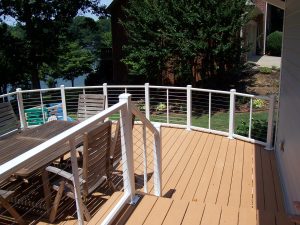
There are several good choices for railing material to go with a composite deck. Wood balusters are the least costly option. Even then we still recommend a composite top cap, as the horizontal surface of wood will take a beating from the sun. Composite balusters are a good choice, as are wrought iron balusters. For a house on the lake, we really like cable railing, which provides the most unobstructed view of the water beyond.
After choosing the composite decking product and railing products, we also like to use hidden fasteners for the deck. While a bit more expensive, this choice provides a cleanly finished, quality product.
When considering whether to use composite vs. wood decking, cost is always an issue. The labor is about the same, so it’s really the product cost that differs. Maybe it’s 30% more, but……….a composite deck never has to be stained, since the colorant comes integral to the product….or re-stained every couple of years. If you’re considering cost to maintain your wood deck, you can calculate your ROI based on labor and materials to strip, clean, replace boards, and stain.
A couple of questions to ask yourself:
1—how long do we plan to stay in this home (to calculate ROI)?
2—would composite decking be expected in a home at my price point?
3—will my home present better and therefore sell faster with a composite deck?
After you’ve considered all these variables, you can decide whether to use composite decking in your new home — or replace decking in your current home.
Below a sample of composite decking with cable railing: